


27 Advanced Design Patterns Interview Questions For Senior Developers

In software engineering, a design pattern is a general repeatable solution to a commonly occurring problem in software design. A design pattern isn’t a finished design that can be transformed directly into code. It is a description or template for how to solve a problem that can be used in many different situations. Follow along and refresh your knowledge of 29 Expert Design Patterns Interview Questions (answered and solved) for your next senior developer/architect tech interview.
Q1: What is Design Patterns and why anyone should use them?
Design patterns are a well-described solution to the most commonly encountered problems which occur during software development.
Design pattern represents the best practices evolved over a period of time by experienced software developers. They promote reusability which leads to a more robust and maintainable code.
Q2: What is Builder pattern?
Builder pattern builds a complex object using simple objects and using a step by step approach. This builder is independent of other objects.
The Director class is optional and is used to make sure that the building steps are executed in the right order with the right data by the right builder. It's about validation and delegation.
Builder/Director pattern's steps invocations could be semantically presented by method chaining or so called Fluent Interface syntax.
Pizza pizza = new Pizza.Builder()
                       .cheese(true)
                       .pepperoni(true)
                       .bacon(true)
.build();Q3: What is Dependency Injection?
Dependency injection makes it easy to create loosely coupled components, which typically means that components consume functionality defined by interfaces without having any first-hand knowledge of which implementation classes are being used.
Dependency injection makes it easier to change the behaviour of an application by changing the components that implement the interfaces that define application features. It also results in components that are easier to isolate for unit testing.
Q4: What is Factory pattern?
Factory pattern is one of most used design pattern and comes under creational patterns category.
In Factory pattern, we create object without exposing the creation logic to the client and refer to newly created object using a common interface.
Pro's:
- Allows you to hide implementation of an application seam (the core interfaces that make up your application)
- Allows you to easily test the seam of an application (that is to mock/stub) certain parts of your application so you can build and test the other parts
- Allows you to change the design of your application more readily, this is known as loose coupling
Con's
- Makes code more difficult to read as all of your code is behind an abstraction that may in turn hide abstractions.
- Can be classed as an anti-pattern when it is incorrectly used, for example some people use it to wire up a whole application when using an IOC container, instead use Dependency Injection.
Q5: What is Inversion of Control?
Inversion of control is a broad term but for a software developer it's most commonly described as a pattern used for decoupling components and layers in the system.
For example, say your application has a text editor component and you want to provide spell checking. Your standard code would look something like this:
public class TextEditor {

    private SpellChecker checker;

    public TextEditor() {
        this.checker = new SpellChecker();
    }
}
What we've done here creates a dependency between the TextEditor and the SpellChecker. In an IoC scenario we would instead do something like this:
public class TextEditor {

    private IocSpellChecker checker;

    public TextEditor(IocSpellChecker checker) {
        this.checker = checker;
    }
}
You have inverted control by handing the responsibility of instantiating the spell checker from the TextEditor class to the caller.
SpellChecker sc = new SpellChecker; // dependency
TextEditor textEditor = new TextEditor(sc);
Q6: What is Iterator pattern?
Iterator pattern is very commonly used design pattern in Java and .Net programming environment. This pattern is used to get a way to access the elements of a collection object in sequential manner without any need to know its underlying representation. Iterator pattern falls under behavioral pattern category.
Q7: What is Proxy pattern?
In proxy pattern, a class represents functionality of another class. This type of design pattern comes under structural pattern.
In proxy pattern, we create object having original object to interface its functionality to outer world.
Q8: Explain the Single Responsibility Principle (SRP)?
Single responsibility is the concept of a Class doing one specific thing (responsibility) and not trying to do more than it should, which is also referred to as High Cohesion.
Classes don't often start out with Low Cohesion, but typically after several releases and different developers adding onto them, suddenly you'll notice that it became a monster or God class as some call it. So the class should be refactored.
Q9: What are the difference between a Static class and a Singleton class?
Following are the differences between a static class and a singleton class.
- A static class can not be a top level class and can not implement interfaces where a singleton class can.
- All members of a static class are static but for a Singleton class it is not a requirement.
- A static class get initialized when it is loaded so it can not be lazily loaded where a singleton class can be lazily loaded.
- A static class object is stored in stack whereas singlton class object is stored in heap memory space.
Q10: What is Adapter Pattern?
Adapter pattern works as a bridge between two incompatible interfaces. This pattern involves a single class which is responsible to join functionalities of independent or incompatible interfaces (adaptees).

A real life example could be a case of card reader which acts as an adapter between memory card and a laptop. You plugin the memory card into card reader and card reader into the laptop so that memory card can be read via laptop.
Q11: What is Bridge pattern?
Bridge pattern is used when we need to decouple an abstraction from its implementation so that the two can vary independently. This type of design pattern comes under structural pattern as this pattern decouples implementation class and abstract class by providing a bridge structure between them.
The bridge pattern is useful when both the class and what it does vary often. The class itself can be thought of as the abstraction and what the class can do as the implementation. The bridge pattern can also be thought of as two layers of abstraction.
This pattern involves an interface which acts as a bridge which makes the functionality of concrete classes independent from interface implementer classes. Both types of classes can be altered structurally without affecting each other.
The example of bridge pattern implementation is when:
                   ----Shape---
                  /            \
         Rectangle              Circle
        /         \            /      \
BlueRectangle  RedRectangle BlueCircle RedCircle
refactored to:
          ----Shape---                        Color
         /            \                       /   \
Rectangle(Color)   Circle(Color)           Blue   Red
or in general when:
        A
     /     \
    Aa      Ab
   / \     /  \
 Aa1 Aa2  Ab1 Ab2
refactored to:
     A         N
  /     \     / \
Aa(N) Ab(N) 1 2Q12: What is Command pattern?
Command pattern is a data driven design pattern and falls under behavioural pattern category. A request is wrapped under an object as command and passed to invoker object. Invoker object looks for the appropriate object which can handle this command and passes the command to the corresponding receiver which executes the command.
Q13: What is Decorator pattern?
Decorator pattern allows a user to add new functionality to an existing object without altering its structure. This type of design pattern comes under structural pattern as this pattern acts as a wrapper to existing class.
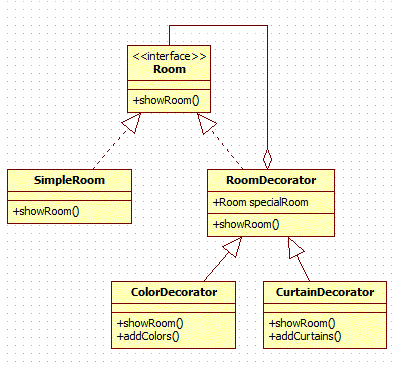
This pattern creates a decorator class which wraps the original class and provides additional functionality keeping class methods signature intact.
Q14: What is Facade pattern?
Facade pattern hides the complexities of the system and provides an interface to the client using which the client can access the system. This type of design pattern comes under structural pattern as this pattern adds an interface to existing system to hide its complexities.
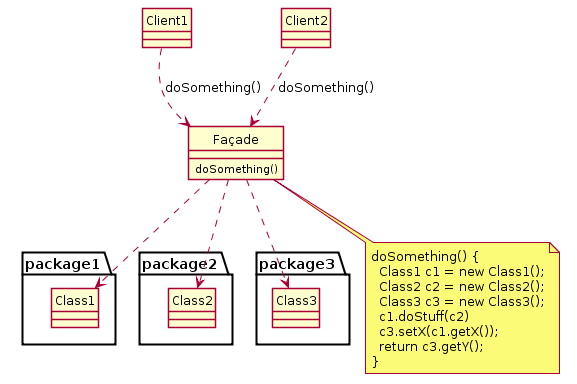
This pattern involves a single class which provides simplified methods required by client and delegates calls to methods of existing system classes.
Q15: What is Observer pattern?
Observer pattern (also known as Publish-Subscribe Pattern) is used when there is one-to-many relationship between objects such as if one object is modified, its dependent objects are to be notified automatically. Observer pattern falls under behavioral pattern category.
An object with a one-to-many relationship with other objects who are interested in its state is called the subject or publisher. The observers are notified whenever the state of the subject changes and can act accordingly. The subject can have any number of dependent observers which it notifies, and any number of observers can subscribe to the subject to receive such notifications.
Observer pattern uses two actor classes:
- The Observer (os Subscriber) abstract class provides an
update()method which will be called by the subject to notify it of the subject’s state change. - The Subject (or Publisher) class is also an abstract class and defines four primary methods:
attach(),detach(),setState(), andnotify()
Q16: What is the Chain of Responsibility pattern?
As the name suggests, the chain of responsibility pattern creates a chain of receiver objects for a request. This pattern decouples sender and receiver of a request based on type of request. This pattern comes under behavioural patterns.
In this pattern, normally each receiver contains reference to another receiver. If one object cannot handle the request then it passes the same to the next receiver and so on. The chain of responsibility is an object oriented version of the if ... else if ... else if ....... else ... endif idiom, with the benefit that the condition–action blocks can be dynamically rearranged and reconfigured at runtime.
Q17: Could you provide an example of the Single Responsibility Principle?
Q18: Explain what is Composition over Inheritance?
Q19: How is Bridge pattern is different from Adapter pattern?
Q20: What is GOD class and why should we avoid it?
Q21: Why layering your application is important? Provide some bad layering example.

Q22: Why should I isolate my domain entities from my presentation layer?
Q23: Why would I ever use a Chain of Responsibility over a Decorator?
Q24: Could you explain the difference between Façade vs. Mediator?
Q25: Could you explain what is the Deadly Diamond of Death?
Q26: Explain difference between the Facade, Proxy, Adapter and Decorator design patterns?
Q27: What is the difference between Cohesion and Coupling?

Rust has been Stack Overflow’s most loved language for four years in a row and emerged as a compelling language choice for both backend and system developers, offering a unique combination of memory safety, performance, concurrency without Data races...

Clean Architecture provides a clear and modular structure for building software systems, separating business rules from implementation details. It promotes maintainability by allowing for easier updates and changes to specific components without affe...
Azure Service Bus is a crucial component for Azure cloud developers as it provides reliable and scalable messaging capabilities. It enables decoupled communication between different components of a distributed system, promoting flexibility and resili...


FullStack.Cafe is a biggest hand-picked collection of top Full-Stack, Coding, Data Structures & System Design Interview Questions to land 6-figure job offer in no time.
Coded with 🧡 using React in Australia 🇦🇺
by @aershov24, Full Stack Cafe Pty Ltd 🤙, 2018-2023
Privacy • Terms of Service • Guest Posts • Contacts • MLStack.Cafe
 based on 86 Trustpilot
  Reviews